Published August 14, 2018 11:00AM
5 Exercises For A Stronger Body
Getting strong doesn’t happen overnight. Start doing these five exercises to bring a little bit of strength training into every workout.
(Photo: Alpha: Jason Riker)

Excerpted from Get Strong for Women, reprinted by permission of DK, a division of Penguin Random House LLC. Copyright © Alex Silver-Fagan.
Getting strong doesn’t happen overnight. It is a gradual process that requires commitment to routine, dedication to form and drive to continually push yourself every day. Each time you pick up a weight, you are training your muscles to become stronger and more adept at functional movement.
Butterfly Sit-Up
A traditional sit-up can cause tension in your hip flexors, but this variation of the sit-up opens up your hips and knees and keeps them loose throughout your whole workout. Perform the movement slowly, letting the abdominal muscles do the work.
- Lie on your back. Bend your knees, place the soles of your feet together and pull your heels toward your body. Extend your arms above your head along the floor. Inhale.
- Exhale and use your core to lift your torso off the floor, reaching your hands to your feet. Then return to the starting position in a slow, controlled manner. That is one rep. Repeat for the number of reps given in your workout.
Harder variation: Dumbbell Butterfly Sit-Up
Hold a dumbbell in your hands and perform the sit-up as described.
ADVERTISEMENT
Exercise Profile
Equipment: None
Primary muscle group: Abdominals
Secondary muscle group: Hips, glutes, upper back, shoulders


Fast Mountain Climber
Boost your heart rate and metabolism while toning your core with this dynamic exercise. It primarily works the abs, which stabilize your shifting position. The faster you move, the more calories you will burn.
- Begin in a high plank position with your shoulders above your hands and your toes hip-width apart. Distribute your weight evenly between your toes and hands.
- Quickly pull your right knee toward your chest while keeping your upper body stable and your shoulders above your wrists.
- Quickly switch your legs, pulling your left knee to your chest and returning your right foot to the floor. Alternate raising each leg, maintaining a rapid pace for the time given in your workout.
Exercise Profile
Equipment: None
Primary muscle group: Abdominals
Secondary muscle groups: Shoulders, arms, legs, hips


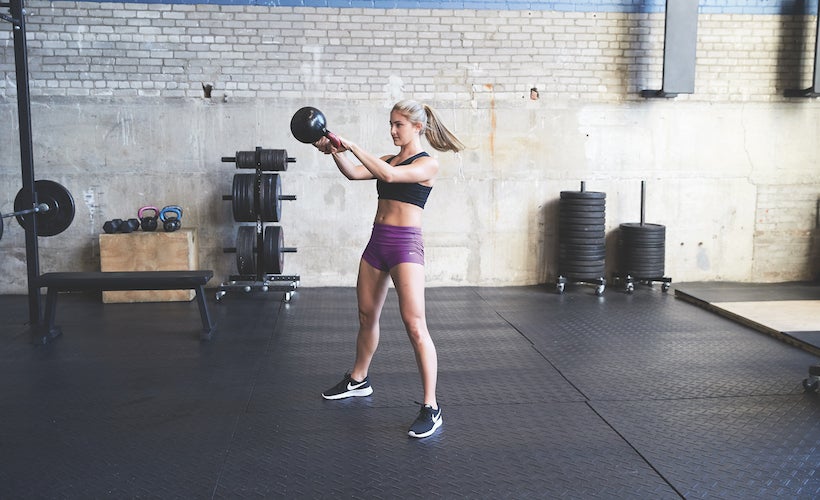
Russian Kettlebell Swing
Swinging a heavy weight between your legs is a great way to develop hip power and glute strength. Practicing this explosive hip movement helps you in nearly all other exercises and is a fast way to build athleticism.
- Stand with your feet wider than shoulder-width apart, and slightly turn your toes outward. Place a kettlebell about 1½ feet (0.5m) in front of you. Hinge forward at the hips, bend your knees and grab the handle of the kettlebell with both hands.
- Slightly straighten your knees and swing the kettlebell back between your legs.
- Aggressively extend your legs and thrust your hips forward to swing the kettlebell up to eye level. Use your glutes and hips, not your arms, to drive the movement. That is one rep.
- Immediately hinge forward and push your hips back to enter into the next rep. Repeat for the number of reps given in your workout.
Harder variation: Single-Arm Russian Swing
Perform the exercise as described, but use one arm at a time. Start with a lighter weight. You can switch the kettlebell quickly from hand to hand between reps, as if it is floating.
Exercise Profile
Equipment: Kettlebell
Primary muscle groups: Glutes, hamstrings, hips, shoulders
Secondary muscle groups: Core, back


Rear-Foot Elevated Split Squat
Also known as an RFE or Bulgarian split squat, this exercise is one of the best for developing lower-body strength and power. It increases the flexibility of your hip flexors and challenges your core to maintain balance.
- Place the top of your left foot on a bench behind you, and plant your right foot firmly on the floor. Hold a dumbbell in each hand at your sides.
- Inhale, bend both of your knees and lower your left knee straight down until your right thigh is parallel to the floor.
- Exhale and push through your right heel to stand up. That is one rep. Repeat on this side for the number of reps given in your workout.
- Reverse your stance and perform the squat with your right foot elevated. Repeat for the number of reps given in your workout.
Easier variation: Bodyweight RFE split squat
Perform the squat as described, but without dumbbells. Keep your hands near your chest.
Exercise Profile
Equipment: Dumbbells, bench
Primary muscle groups: Glutes, quads
Secondary muscle groups: Hips, core


T Push-Up
This advanced push-up variation is a fantastic way to build core strength and stability while also stretching your chest muscles and toning your upper back. The core rotation targets your obliques, leaving your entire body exhausted.
- Begin in a high plank position with your shoulders above your hands and your toes wider than hip-width apart. Shift your weight forward to your hands and engage your core.
- Inhale and bend your elbows to lower your chest until your elbows are bent to 90 degrees.
- Exhale and push through your palms to raise your body. In a continuous motion, fully extend your right arm, rotate your core to the left and raise your left arm to the ceiling. Pause.
- Return your left arm to the starting position. That is one rep.
- Repeat the exercise, but this time raise your right arm. That is another rep. Alternate raising each arm for the number of reps given in your workout.
Exercise Profile
Equipment: None
Primary muscle groups: Chest, core
Secondary muscle groups: Shoulders, triceps, back


Related:
Strength Training Tips From Fitness Expert Alex Silver-Fagan