Published February 29, 2024 09:43PM
Road to the Trials: A Race to Remember
In her post-race report from 2024 U.S. Olympic Marathon Trials, elite mother-runner Neely Gracey shares her takeaways from the experience—and a few surprises.

(Photo: Neely Gracey)
This is part of a continuing series at Women’s Running, with elite runner Neely Gracey, where she shared her journey and advice as she prepared for the 2024 U.S. Olympic Marathon Trials in Orlando in February.
Check out all of Neely’s Road to the Trials series
By Neely Gracey with Cindy Kuzma
Trust the process, trust the pace, I told myself for the first few miles. Toward the middle, I focused on form. As the drizzle and wind picked up in the last 5K, I held strong. I crossed the finish line first, and was thrilled with my time: 2:35:28.
If you paid any attention to the 2024 U.S. Olympic Marathon Trials in Orlando on February 3, you’re likely wondering what on earth I’m talking about. You know that three incredible women—Fiona O’Keeffe, Emily Sisson, and Dakotah Lindwurm—took the first three spots, running sub-2:26 to make the Olympic team. And there wasn’t a raindrop in sight on the warm Florida morning.
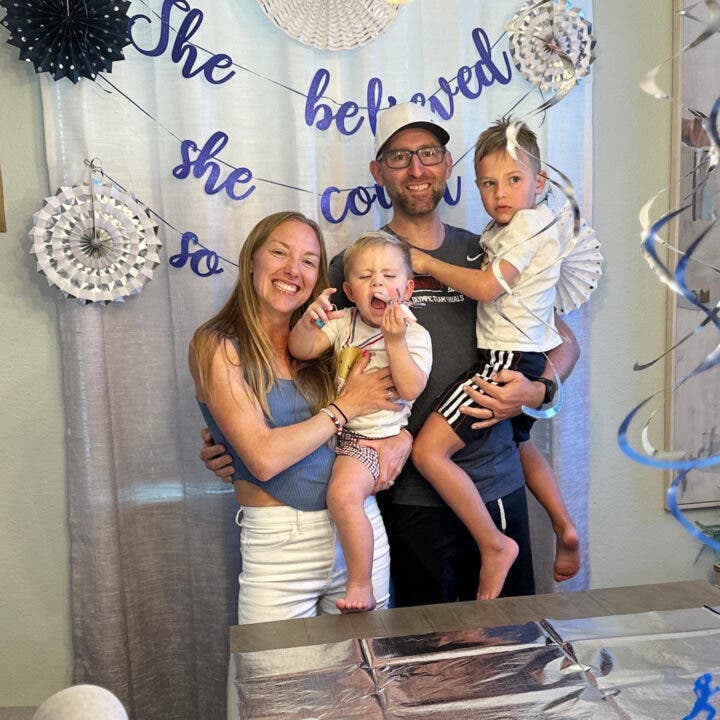
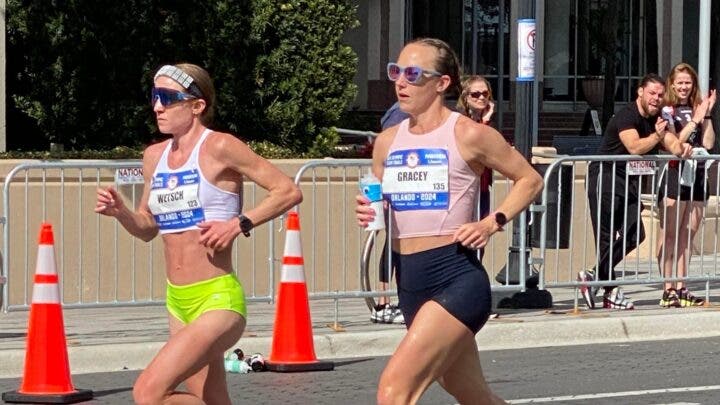
That day, I achieved something I never had in more than a decade of pro running: After qualifying four times, I finally finished an Olympic Trials race. When I crossed the line in 2:37:09, the 42nd finisher in what was billed as the deepest American women’s marathon field ever assembled, I had so many reasons to celebrate. I only had to look around at the surprise party my family threw me later that day to remember all the gifts in my life.
But something didn’t sit right in my heart—or my gut. My plan for the Trials was to go out at a conservative pace and accelerate at the end if I could. However, aiming to stay ahead of the heat and dehydration, I was aggressive with my fluid intake early in the race. By mile 10.4, when I downed my third bottle, my stomach was sloshing.
ADVERTISEMENT
Every time I tried to pick up the pace, my nausea increased. I couldn’t take in any more fluids or gels. By the final lap, I felt like I was jogging to keep from puking or bonking. So while I was elated to finish and proud of myself for adjusting my goals for the conditions I faced on the day, I couldn’t help wondering what could have been.
RELATED: 3 Keys to Race-Day Fueling
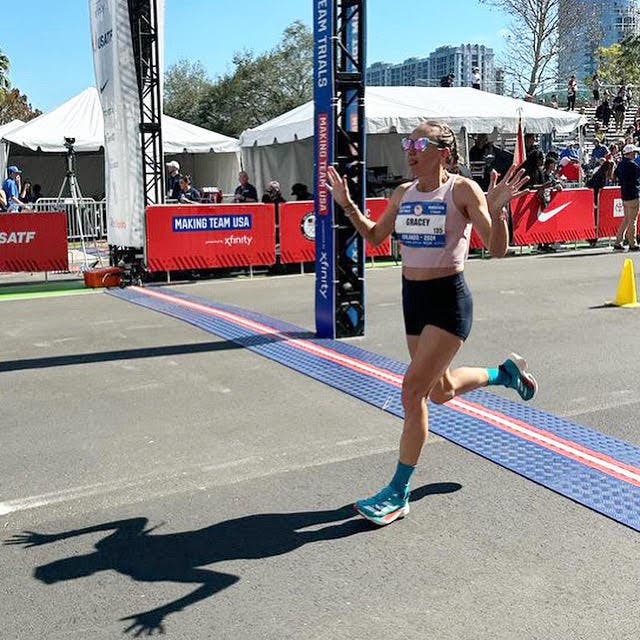
Afterward, when people asked how I was recovering, I kept telling them “annoyingly well.” I felt like I’d just done another long run, not a full-effort marathon. By Thursday, five days after the race, I already felt itchy to run again.
On a pre-race call with one of my athletes who was heading to race in Arizona, an idea popped into my head. The Mesa Marathon was that coming weekend—could I possibly try again? I posed the idea to my coach and husband, Dillon, who was surprisingly supportive. He reminded me that I do all this for fun, and if I thought that’s what awaited in Arizona, I should go for it.
So on Friday morning I registered, booked a flight for that evening, and got in just after 8 P.M. I stayed the night with my friend (and new member of my Get Running Coaching team!) Rochelle Basil, who was there to race the 10K. The next morning, I lined up for another 26.2, and crossed the line with a victory and a full heart.
I wouldn’t recommend this approach for everyone. (Although, now I can understand what my athletes who take on the Boston-London double go through!) In this case, though, my body was ready and a redemption race was what my heart needed. I had the full support of my coach, my family, and the rest of my team to make it happen.
ADVERTISEMENT
During the Trials, I was surviving, not thriving—and at this point in my career, happiness is the top priority for me. In Mesa, I put all my hard-earned fitness to good use in a race I enjoyed, despite the final blast of wind and drizzle. I can now close out the season knowing I gave it my all. I feel ready for a rest before I plan my next adventure.
Lessons from the Road
As I shared in part 5 of this series, I walk all my athletes through a post-season and post-race analysis. I did the same thing myself, highlighting what went well and what didn’t, and what I can change going forward.
What works for each person is different, of course, but we can all learn from each other’s experiences. Here are the key lessons I’m taking away from this season as I plan for the future.
Time the taper right
Tapering is a tricky balance of backing off enough to freshen up without cutting back so much that you feel flat. Every runner responds differently; some race better if they back off earlier, while others feel best with a short ramp-down.
ADVERTISEMENT
Because it’s been a while since I had a full, healthy marathon training cycle, I wasn’t sure where my body would land. I was conservative and began decreasing my mileage three weeks out from the Trials. Even before the stomach issues set in, I noticed a lack of pep in my step during the race. For my next marathon, I’ll try a two-week taper, instead.
RELATED: Road to the Trials: Trust the Process
Fuel by the clock
Fueling is another delicate balance. You want to take in lots of carbs and fluids, but your digestive system can only absorb so much at a time. Most people can handle somewhere between 5 and 20 ounces of fluids per hour, according to my team nutritionist, Kristin Lafontaine; carbs are more variable, with the minimum being 50 grams per hour. Research shows runners can use up to 120 grams per hour, most need to work up to that amount. Heat and pace influence the equation, too.
While I’d practiced diligently in training, I still overdid it in the first hour of the Trials race, not taking into account that the bottle stations were front-loaded (there were three in the first 10.4 miles, then three more for the next 16 miles).
ADVERTISEMENT
When I went back over this with Kristin, we realized I took in 32 ounces of fluid and 115 grams of carbs—far more than my body could have handled in 60 minutes. When I race again, I’ll calculate the number of ounces and grams I need per hour—aiming for no more than 20 ounces of fluids and about 75 grams of carbs—and portion my fluids and gels accordingly, regardless of where the aid stations fall.
Maintain a comfortable routine
The last month before the race, we went to stay with my in-laws in Florida. This trip served many purposes—allowing me to adapt to the heat, providing extra help with childcare, and giving my boys time in the sun and with their loving grandparents.
I’m so grateful and fortunate to have had this opportunity and wouldn’t change how we handled it. The trip was about far more than my performance. It was filled with moments I’ll never forget—my oldest son Athens learned to do a handstand at the bottom of the pool, for example, and bravely got on a zipline at Gatorland.
ADVERTISEMENT
But I still struggled a bit with some of the shifts that come with being away from home—for instance, not having all the equipment to stick to my regular lifting routine. The last two weeks, as we hunkered down to avoid getting sick and I scaled back on my coaching duties, I almost felt like I had too much downtime.
All this cemented the knowledge that for most races, I prefer staying in my familiar environment and work routine for as long as possible, making a quick trip as I did for Mesa. When I do have to travel for longer—as I will before the Berlin Marathon this fall—extending the trip afterward is probably a better bet than getting there early. That way, I can be fully present for downtime with my family.
Follow your heart
As I look back on my full buildup to the Trials, my most important takeaway was how much joy I could feel even while training at a high level. In my younger days, I think I’d be shocked at how much I could gain by releasing some of my fear, anxiety, and need to control every minute of my schedule or mile of my runs.
ADVERTISEMENT
I did workouts I hadn’t completed in years, faster than I ever had before. I hit my highest mileage totals without planning to, spending 10 weeks over 80 miles and two in the 90s. I did nine long runs of 20-plus miles—workouts I love and that my body adapts to beautifully. I got to the start—and finish—of the Trials happy, healthy, and strong. And, I lined up again a week later not because I felt pressured, but because I wanted to.
The best part is that I did all this while maintaining a full life as a wife, mom, and coach. My family supported me; afterward, we all celebrated together. (They even threw me another party after Mesa with some great friends who showed up at a moment’s notice—and then knew to leave by 7 p.m. This mama was officially exhausted!)
So as I reflect on this journey, I can’t help but feel immense gratitude for where I’ve arrived in life, and every single person who’s supported me along the way. That includes you, if you’ve read this far. Thank you so much for joining me on this journey!
Yes, I achieved some of my race goals and missed others, but when I think about my bigger aims—for the race, for this series of articles, and for my life itself—I see that I’ve succeeded beyond my wildest dreams.
ADVERTISEMENT
My greatest hope was to tell you that your goals matter—you, the mother-runners, the early risers, the athletes with full lives who show up anyway. You don’t have to put your athletic ambitions aside when you have a family, start your career, or otherwise find your life progressing and shifting. Breakthroughs are still possible, even if the route to get there looks different than it has in the past.
I encourage every one of you to find that goal that lights you up and go for it. Your breakthrough is coming—I can feel it. But I also want you to remember that you’re far more than a finishing time, an age-group award, or even an Olympic berth.
What I’ve learned even more in these past few months is that the striving defines you, not the outcome. Even as you dream big, celebrate each small win, each step of the journey. Life will bring you many beautiful moments, in your running shoes and outside of them, as long as you stay open to them.
#TrustTheProcess
Neely
RELATED: These Half Marathons Need To Be On Your Bucket List