Published March 13, 2021 03:00AM
Improve Your Uphill Running with Step-Ups
Why step-ups make you a more powerful runner, techniques and tips for how to do them, and two sample workouts.
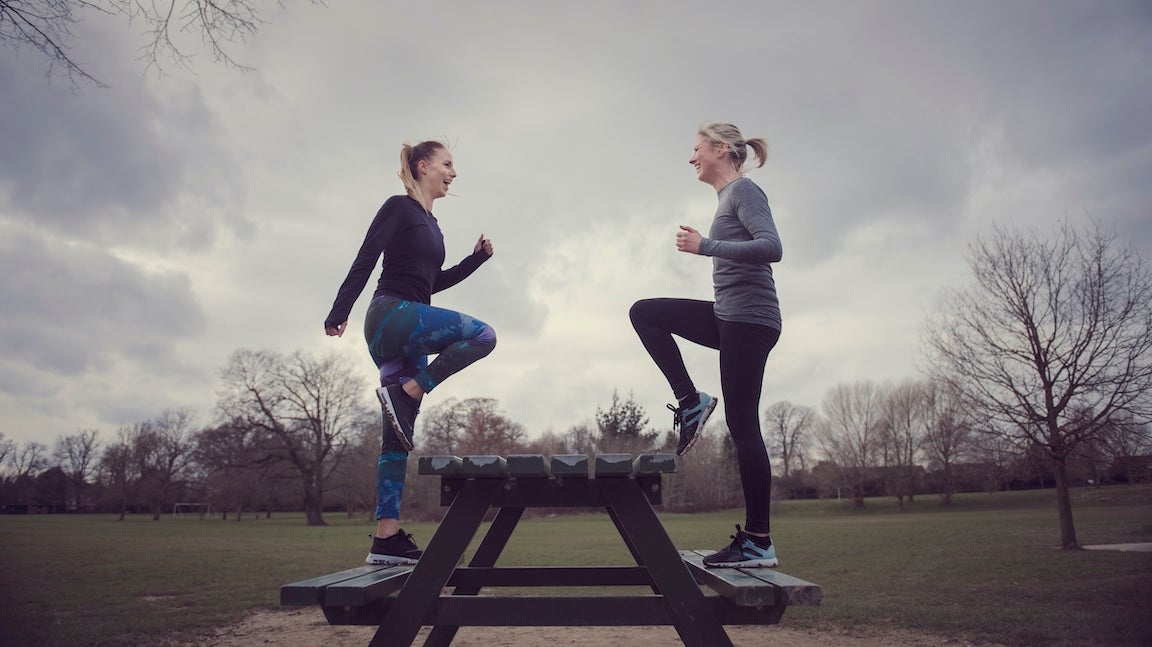
(Photo: Getty Images)
You probably know that strength training increases your running efficiency and durability. The step-up is a strength exercise that belongs in your strength program for several reasons. First, running is a single-leg (unilateral) activity, thus some of your lifting should include unilateral exercises. Second, running uphill involves stepping up repeatedly. (Trail runners often need to step up to considerable heights.) Step-ups also resemble the pedaling motion on a bike, so if you’re a cyclist or triathlete then step-ups will help your cycling. Finally, step-ups demand stability and strength from the knee and hip extensors, the hip ad/abductors, the feet, and the core, making them an excellent investment of your workout time.
Perform step-ups in the gym by stepping on a plyometric box, an adjustable aerobic step, or a weight bench. Outdoors, use a picnic bench; a tree stump; or a large, flat rock. Your step must be stable and the area around your step must be clear of tripping hazards.
RELATED: How to Make Any Bodyweight Exercise More Challenging (Without Adding Weights)
Technique
The working leg is the leg used to both step up and control your descent. You may alternate working legs or do all your reps on one leg then all your reps on the other.
Up: Place your working foot on a step. Brace your abs. Shift your weight forward slightly and drive up hard through your working leg. Stand up with your working leg locked, and your glutes, quads, and abs engaged. Feel your working leg doing the work. Avoid bouncing up off the trail leg.
Down: Lean forward slightly and step down with the non-working leg. Use your working leg to control your descent. Don’t get lazy and plummet to the ground. You can move as fast as you want so long as you’re in control. Bring your working leg to the ground and repeat the exercise for the given number of reps.
ADVERTISEMENT
Variables
Add variety and adjust the difficulty of step-ups by manipulating the variables below. Start easy and progress gradually by changing one or two variables.
Height
Low step-ups are easier than high step-ups. High step-ups recruit more muscle mass than low step-ups. Start with low step-ups (around 10”) and progress over the course of weeks to higher steps (possibly 20”). Taller people can use higher steps than shorter people. To check: Flex your hip, knee, and foot to bring your thigh parallel to the ground; your foot height is the highest step height you’ll ever need.
Stability
Increase or decrease step-up difficulty through your reliance on the non-working leg for balance. From least to most difficult, here are three options:
- Step-up to two legs: Step up and place the non-working foot fully on the step and distribute 50% of your body weight through each leg.
- Step up to toe-tap: Step up and lightly tap the non-working toe to the step, putting most of your weight through the working leg.
- Step up to single-leg balance: Step up and drive the non-working leg up, lifting that knee and foot high as if you’re about to stomp the ground. The working leg does all the work and all the balancing.
You can load the step-up asymmetrically by holding one weight in the hand opposite your working leg. This creates additional load on the foot, glutes, and abs on the working-leg side. You may use asymmetrical loading with any of the stability strategies described above. Eventually, you should be able to step up to single-leg balance with an asymmetrical load.
RELATED: Everything You Need to Know About Runner’s Knee
Direction
Orient yourself in different positions relative to the step and step up at different angles.
- Forward: The standard step-up. Face the step straight on and step up.
- Same side lateral: Stand parallel to the step and step up from the side using the leg closest to the step.
- Opposite side lateral: This is a crossover step. Stand offset near one corner of the step. Use the leg furthest from the step, and step across up on to the step
- Same side rotational: Stand parallel to the step. Rotate toward the step and step up with the leg closest to the step. The motion is akin to stepping out of a car. Step down while rotating back to the start position.
Load
Load the step-up by holding dumbbells, kettlebells, a sandbag, or similar implements in your hands. Wear a weight vest or weighted backpack. Or, put a barbell on your back or across your shoulders.
Speed
The plyometric step-up is an aggressive jump. Drive through the working leg, and accelerate into the air. Both feet leave the ground. Land and repeat as fast as possible for the prescribed number of reps. Note: Don’t load this kind of a step-up.
Tips
If balance or control is difficult, these cues will help:
- Foot engagement: Press your big toe and second toe into the ground and grip the step with your working foot.
- Use a mirror: Stand facing a mirror and watch your working-leg knee cap. Keep the knee cap aimed straight ahead as you step up and down.
- Hip hinge: Hip hinging recruits the glutes resulting in more control and strength. Think of leaning your chest forward as you step up and step down.
Sample Routine
Two strength workouts (workouts A and B) per week is ideal. Separate them by 48–72 hours. Work to where you can maybe do two more reps in good form. Don’t exert yourself to the point of failure. Add weight if you can do 8–10 reps. There are many ways to incorporate step-ups into your routine. Here’s one example:
Workout A: Use a park bench after an easy run. Do one set of 6–10 reps of each of the multi-directional step-ups. Use the amount of balance help you need. Try to progress to single-leg balance. Wear a loaded backpack if you need additional weight.
Workout B: Go to the gym. Do 2–3 sets of 6–8 reps per leg for three weeks adding weight and/or increasing step height as you are able. Back-off the fourth week and reduce the workload to your starting weight for a single set of 6 reps. For the next three-week block, add weight and/or increase the step height. Do 3–5 sets of 3–5 reps for three weeks.
Plyometric step-ups: First, make sure you’re ready for plyometrics. Incorporate plyo step-ups 6–8 weeks out from a race. Substitute plyos for your A or B workout. Do 5–6 sets of 3–5 reps per leg with 2–3 minutes rest between sets. Do them explosively and avoid exhaustion. Rest 2–3 minutes between sets.